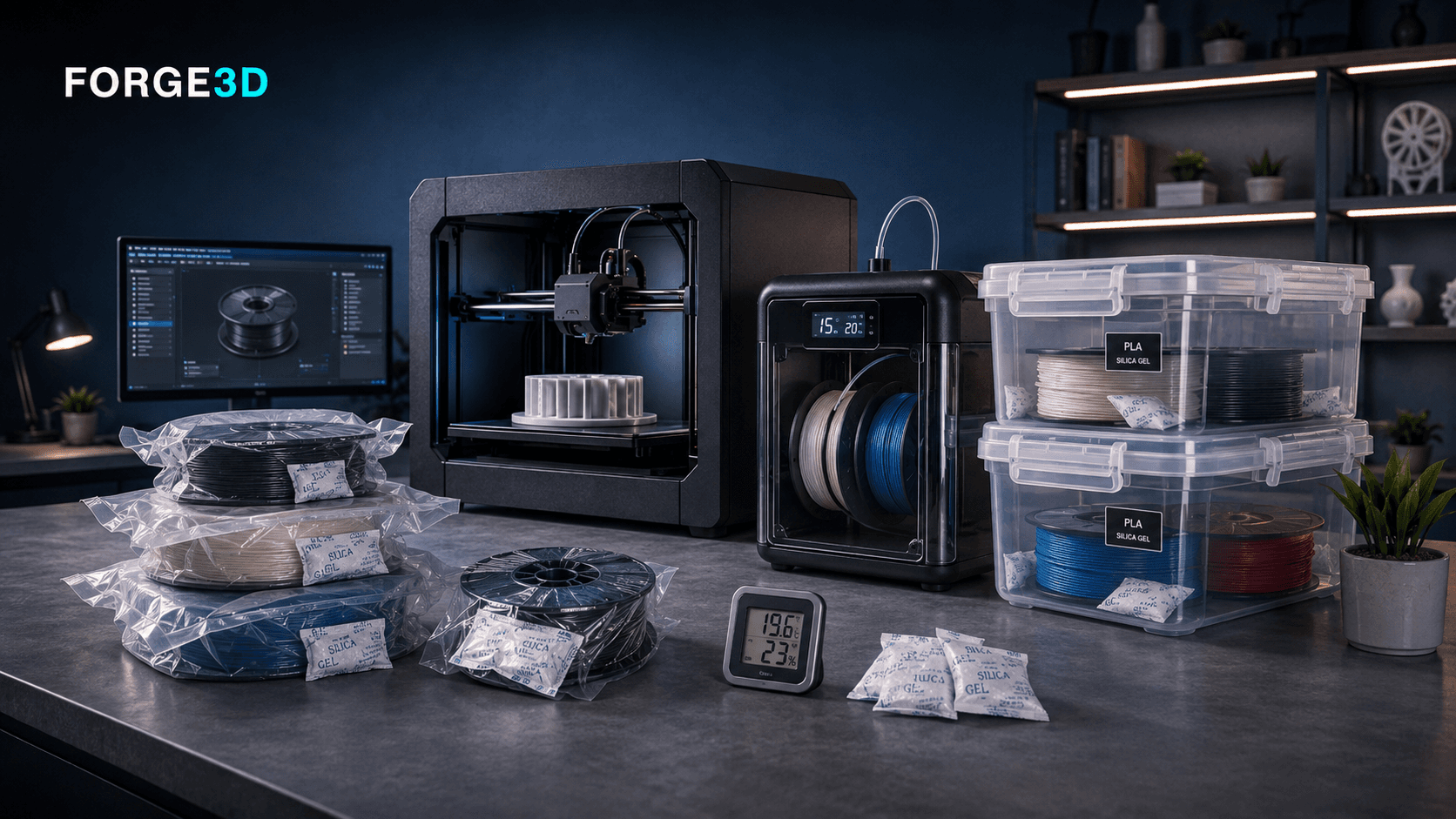
3D printing filament may look simple, but how it is stored can have a major impact on print quality.
Many filament materials absorb moisture from the surrounding air. Over time, this can lead to poor extrusion, weak layers, rough surfaces, stringing, popping sounds during printing, and even complete print failures.
Proper storage helps maintain filament quality and reduces unnecessary waste.
Why Filament Storage Matters
Most 3D printing filaments are hygroscopic to some degree, which means they can absorb moisture from the air.
Some materials absorb moisture very slowly, while others can become affected within hours or days in humid conditions.
When wet filament enters a hot nozzle, the absorbed water can rapidly turn into steam. This can disrupt the extrusion process and create defects in the printed object.
Common signs of moisture-affected filament include:
- Popping or crackling sounds from the nozzle
- Excessive stringing
- Rough or uneven surfaces
- Weak layer adhesion
- Bubbles in the extruded material
- Inconsistent extrusion
- Brittle filament
These problems are often mistaken for printer calibration issues, even though the filament itself may be the real cause.
Which Filaments Are Most Sensitive to Moisture?
Different materials behave differently.
PLA
PLA is relatively easy to store compared with some engineering materials, but it can still absorb moisture over time.
Wet PLA may become brittle and can produce rougher prints or increased stringing.
PETG
PETG absorbs moisture more readily than PLA.
When affected, it may produce visible bubbles, stringing, and inconsistent surfaces during printing.
TPU
Flexible materials such as TPU can absorb moisture relatively quickly.
This can significantly affect extrusion consistency and surface quality.
Nylon
Nylon is one of the most moisture-sensitive common 3D printing materials.
It can absorb significant amounts of moisture from the air and should be stored carefully in a sealed, dry environment.
ABS
ABS is generally less moisture-sensitive than nylon or TPU, but proper storage is still recommended, especially in humid environments.
Use Airtight Containers
One of the simplest ways to protect filament is to store it in an airtight container.
Suitable options include:
- Sealed plastic storage boxes
- Dry boxes designed for filament
- Vacuum storage bags
- Resealable filament bags
The goal is to reduce the amount of humid air that reaches the filament.
For better protection, a desiccant should also be placed inside the container.
Use Desiccant
Desiccants absorb moisture from the air inside a sealed container.
Silica gel is one of the most commonly used options.
Desiccant packets can be placed inside storage boxes or filament bags to help maintain a dry environment.
Some silica gel products change colour when saturated, making it easier to know when they need to be dried or replaced.
It is important to remember that desiccant helps maintain dry conditions, but it may not be sufficient to remove moisture that has already been absorbed deeply into the filament.
Keep Filament Away From Humidity
Humidity is one of the main factors affecting filament storage.
Filament should not be left uncovered for long periods, especially in humid climates.
It is better to return unused spools to sealed storage soon after printing rather than leaving them mounted on the printer for days or weeks.
Air-conditioned rooms can help reduce humidity, but they do not completely eliminate the need for proper storage.
Avoid Direct Sunlight and Heat
Filament should also be stored away from direct sunlight and excessive heat.
High temperatures can deform filament spools or affect certain materials, while ultraviolet exposure may gradually degrade some plastics.
A cool, dry, shaded location is usually ideal.
What Is a Filament Dry Box?
A filament dry box is a container designed specifically to keep filament dry.
Some dry boxes simply provide sealed storage with desiccant, while more advanced versions include heating systems.
Certain models also allow filament to feed directly from the box into the printer.
This can be useful for moisture-sensitive materials such as nylon and TPU, particularly during long prints.
Can Wet Filament Be Recovered?
In many cases, yes.
Moist filament can often be dried using controlled heat.
Common methods include:
- Dedicated filament dryers
- Food dehydrators
- Carefully controlled ovens
However, drying temperature depends on the material.
Using too much heat can soften or deform the filament or even damage the spool.
For this reason, the correct drying temperature and time should always be checked for the specific material being used.
How Long Can Filament Stay Open?
There is no single answer.
The safe exposure time depends on several factors:
- Filament material
- Humidity
- Room temperature
- Manufacturer
- Storage conditions
PLA may remain usable for relatively long periods in dry environments, while nylon or TPU may absorb enough moisture to affect printing much faster.
In humid regions, it is better to assume that filament should be protected whenever it is not actively being used.
Simple Filament Storage Checklist
A practical storage routine can be very simple:
- Keep filament in airtight containers or sealed bags
- Add silica gel or another desiccant
- Store spools away from direct sunlight
- Avoid leaving filament exposed unnecessarily
- Dry moisture-sensitive materials when needed
- Label opened spools if you use several different materials
- Keep particularly sensitive materials such as nylon in dry storage at all times
Final Thoughts
Good filament storage is one of the easiest ways to improve 3D printing reliability.
Many print-quality problems are blamed on the printer, nozzle, or settings when the real issue is moisture in the filament.
Keeping filament sealed, dry, and protected from heat and humidity can improve surface quality, extrusion consistency, layer adhesion, and overall print reliability.
A small amount of effort spent on storage can prevent failed prints and extend the usable life of 3D printing materials.